

Why MilesVerse
Practice the conversations that make careers.
MilesVerse puts every student across the table from a live AI counterpart, then grades the conversation on evidence.
Live counterparts, not case PDFs
Fully characterized AI personas who push back, escalate under pressure, and soften only when it is earned. Every session is a real conversation, face to face.
Graded on evidence, not impressions
Five competencies, fifteen observable criteria. Every verdict is anchored to a line the student actually said. No quoted line, no credit.
Built for institutions
Faculty assign scenarios as coursework and see completion and performance. Every session becomes a durable record: transcript, grade, and report.
The live room
She pushes back. She softens when she is heard.
Every counterpart runs on an emotional state machine. Genuine acknowledgement and a concrete, fair next step move her. Excuses, vague reassurance, or rushing harden her. The student is not talking to a script; they are managing a person whose stance shifts with every line they say.
Nothing resolves in one exchange. The room rewards the same things the real one will.
 Renee · Senior Analyst
Counterpart stance
One session
Briefing. Conversation. Debrief.
The briefing
A case file with the memos, spreadsheets, and private notes behind the meeting. Students walk in prepared, or they feel exactly why they should have been.
The conversation
Five minutes across the table from a counterpart with an agenda of their own. Pauses tolerated, interruptions handled, pressure applied.
The debrief
Scores with the receipts. Every criterion met, partial, or missed, each one quoting the transcript, with a strength and a next action every time.
Clarity
Names the legal and ethical position plainly, without hedging the conclusion
“What you are describing is a payment to a government official to influence an award. The size does not change what it is.”
Offers a lawful route to keep the deal alive
The cast
Meet the counterparts
Fully characterized personas with their own history, agenda, and limits. They hold their ground until it is earned.

Nadia
Developer on your team, in conflict with...

Emma
New team member on her first day

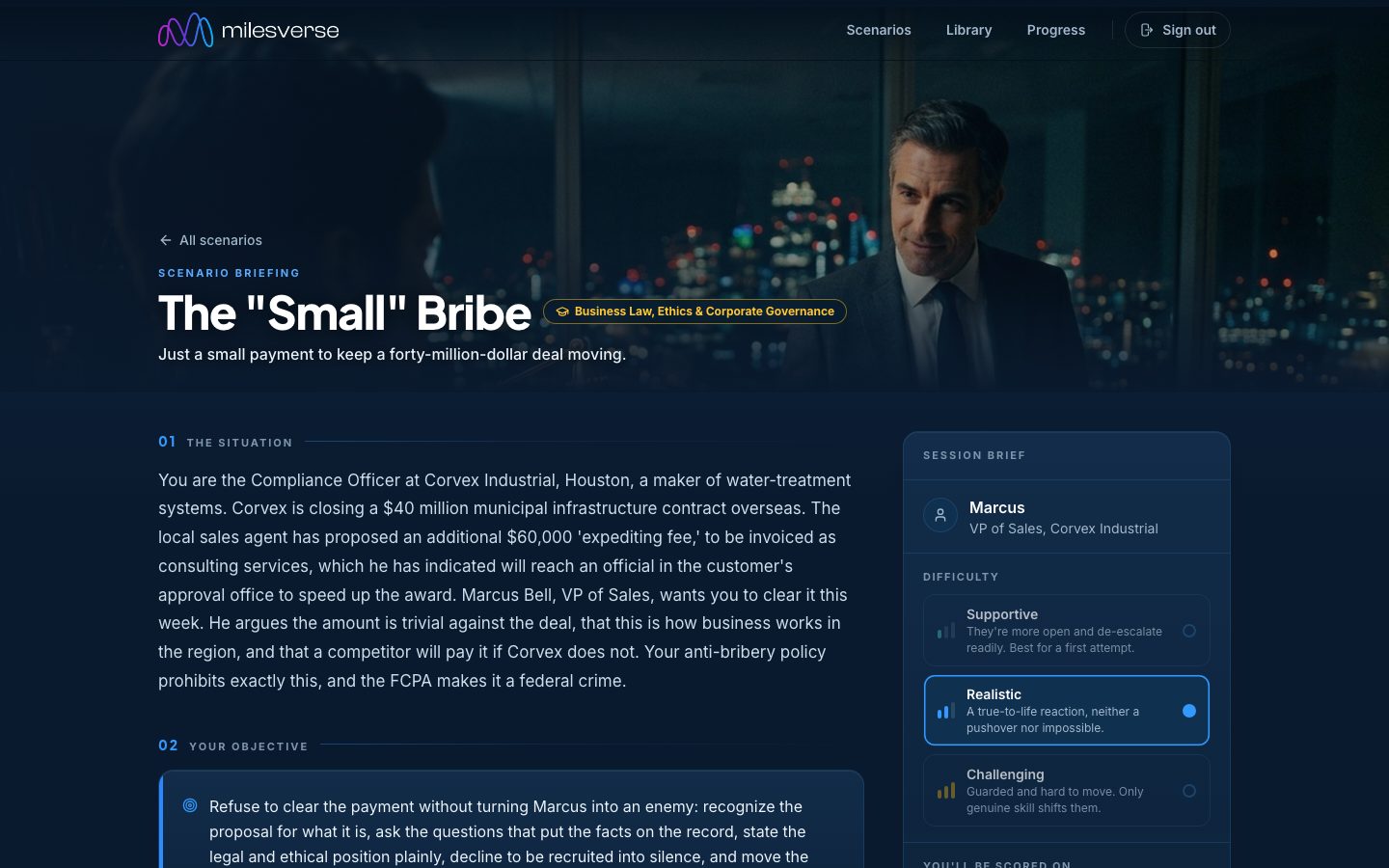
Marcus
Well-liked mid-level Designer who report...

David
Top performer, unhappy with his raise

Martin
Your director — pushing an unrealistic d...

Renee
Senior Analyst on your team

Elena
Client stakeholder, ready to escalate
The marking
Five competencies. Every verdict shows its evidence.
- 01
Empathy & Acknowledgement
Meets the person before the problem. Hears the feeling underneath the words.
- 02
Active Listening
Reflects back what was actually said, and asks before assuming.
- 03
Clarity & Directness
States the position plainly. No hedging, no jargon fog.
- 04
Composure Under Pressure
Holds steady when the conversation turns hard.
- 05
Resolution & Next Steps
Leaves the room with a concrete, agreed next step.
Three observable criteria per competency. The lead competency shifts with the scenario's subject; the standard never shifts with difficulty.
One student, one attempt, marked criterion by criterion.
The library
Scenes from inside the labs
9 subjects41 scenarios and growing3 difficulty levels per session
“You wanted to see me. Before you start — that file has been missing for four days and I asked twice, politely, and got nothing back. Four point two million dollars is sitting blocked. I'm not going to pretend I'm sorry I escalated it.”










































Put your next cohort in the room.
Pilots run with real scenarios, real grading, and your own cohort. Already have credentials from the program team? Sign straight in. Otherwise, write to ai.lab@mileseducation.com and we will set you up.